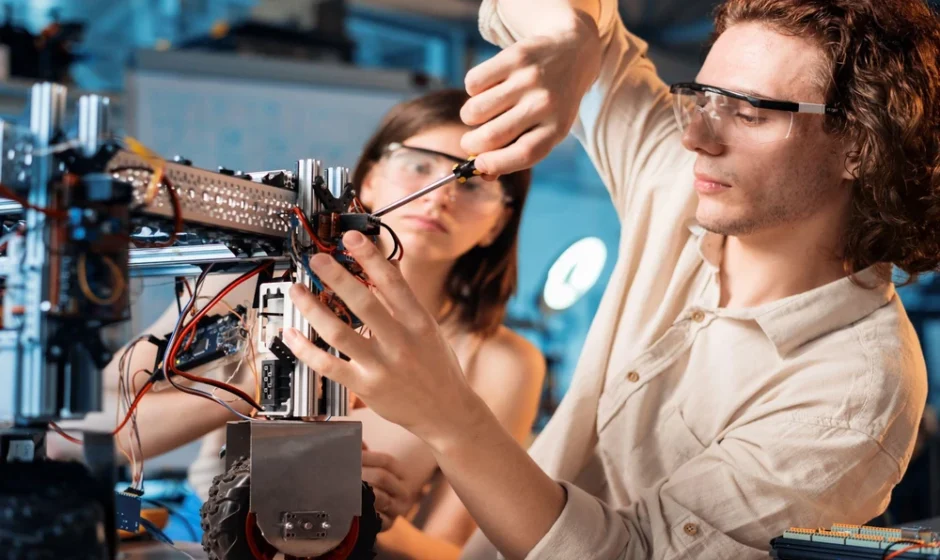

Important Points
- Building a robot focuses on creating a physical machine that can sense, process information, and perform actions.
- Building a complete robotic system involves integrating the robot with software, infrastructure, safety controls, communications, and other equipment.
- Robot development requires knowledge of areas such as mechanics, electronics, programming, sensing, and control.
- Complete robotic systems introduce additional challenges involving system integration, interoperability, reliability, cybersecurity, and deployment.
- Robotics engineering courses can introduce learners to technical disciplines that contribute to both robot development and wider system integration.
Introduction
Robots are used in areas ranging from manufacturing and logistics to healthcare, agriculture, and research. However, creating an individual robot and developing a complete robotic system are different engineering tasks.
A robot is generally a programmable machine designed to perform physical tasks with varying levels of autonomy. A complete robotic system extends beyond the machine itself by combining hardware, software, communications, supporting infrastructure, and human interaction into an integrated operational environment.
Understanding this distinction is relevant to students considering robotics engineering courses, as robotics projects frequently require knowledge from several engineering and computing disciplines. Programmes offered by a private university in Singapore, for example, may differ in curriculum and specialisation, so prospective students should review individual course content carefully.
What Does It Mean to Build a Robot?
Building a robot involves designing and assembling a machine capable of carrying out defined physical functions. Depending on its purpose, the robot may move through an environment, manipulate objects, collect information, or respond to sensor inputs.
Several technical components commonly contribute to a functioning robot:
- Mechanical structure: Frames, joints, wheels, gears, arms, and other physical components determine how the robot moves or interacts with objects.
- Actuators: Electric motors, hydraulic systems, or pneumatic systems create physical movement.
- Sensors: Cameras, encoders, force sensors, proximity sensors, and other devices provide information about the robot and its surroundings.
- Control systems: Controllers process information and determine how actuators should respond.
- Software: Programs define behaviours, process sensor data, control movement, and support decision-making.
- Power systems: Batteries, electrical connections, or other power sources supply the energy required for operation.
Developers must ensure these elements work together within the physical robot. For example, a mobile robot needs suitable motors and wheels, but its control software must also coordinate them accurately.
Building a robot therefore concentrates primarily on creating a functional machine. Building a complete robotic system expands the engineering scope beyond that individual device.
What Does It Mean to Build a Complete Robotic System?
A complete robotic system includes the robot as one component within a wider technical environment. The objective is not simply to make the robot function independently, but to ensure that it operates reliably alongside other systems, equipment, people, and processes.
The distinction can be summarised as follows:
| Area | Building a Robot | Building a Complete Robotic System |
| Main focus | Individual machine | Integrated operating environment |
| Hardware | Robot components | Robot plus supporting equipment |
| Software | Robot control and behaviour | Control, monitoring and integration software |
| Communication | Internal component communication | Networks and external system connections |
| Safety | Robot-level safeguards | Wider operational and human safety |
| Testing | Individual robot performance | End-to-end system performance |
For example, an industrial robot arm may be capable of moving objects between positions. A complete system could additionally include conveyors, machine-vision equipment, safety barriers, programmable controllers, monitoring software, and communication with manufacturing systems.
This wider scope means robotic system development often requires systems engineering alongside mechanical, electrical, electronic, and software expertise. Students comparing robotics engineering courses may therefore encounter subjects covering both individual robot design and broader integration principles.
In short, the robot performs the physical task, while the complete system provides the environment and connections required for that task to contribute to a larger process.
What Are the Challenges for Both?
Both approaches involve technical challenges, although the scale and nature of those challenges differ.
Challenges When Building a Robot
Developers may need to address:
- Accurate mechanical design and movement
- Sensor accuracy and calibration
- Reliable power management
- Real-time control requirements
- Software and hardware compatibility
- Physical durability and maintenance
- Safe operation around people or equipment
A change to one component can also affect other parts of the robot. A heavier battery, for instance, can influence weight distribution, motor requirements, and operating time.
Challenges When Building a Complete Robotic System
System-level development introduces additional concerns, including:
- Integrating equipment from different manufacturers
- Establishing reliable communication between devices
- Coordinating multiple robots or machines
- Managing large amounts of operational data
- Designing appropriate cybersecurity controls
- Planning maintenance without unnecessarily disrupting operations
- Ensuring system-level safety and regulatory compliance
Testing also becomes more complex because engineers must examine interactions between components rather than assessing each device independently.
That said, for students evaluating programmes at a private university or another higher education institution, this distinction can help when comparing modules related to robotics, automation, software, electronics, and systems engineering.
Overall, building a robot requires multidisciplinary engineering at the machine level. Building a complete robotic system adds another layer of integration, requiring individual technologies to function together reliably within a larger operational process.
FAQs
What is the main difference between a robot and a robotic system?
A robot is an individual programmable machine designed to perform physical tasks. A robotic system combines one or more robots with supporting software, equipment, communications, safety measures, and infrastructure.
Does building a robot require both hardware and software knowledge?
Generally, yes. Robot development commonly combines mechanical and electronic components with software used for sensing, control, navigation, or decision-making.
Why is system integration important in robotics?
System integration allows robots to exchange information and coordinate with other equipment or software. Without effective integration, a functional robot may not operate correctly within a wider automated process.
Is systems engineering relevant to robotics?
Yes. Systems engineering helps coordinate requirements, interfaces, testing, safety, reliability, and other factors across multiple components in complex robotic applications.
What subjects are commonly related to robotics engineering?
Relevant areas can include mechanical engineering, electronics, programming, control systems, sensors, automation, computer vision, and systems integration. The exact subjects covered depend on the curriculum of the individual programme.
Interested in developing solutions that go beyond building individual machines? Contact PSB Academy today.